A marine digital twin
built on open GPU compute.
Design → inspect → operate → comply, on a single model backed by the same compute foundation we publish as navatala_gpu.
Design twin — Navatala Ship Design
The as-designed model: hull geometry, hydrostatics, and structure.
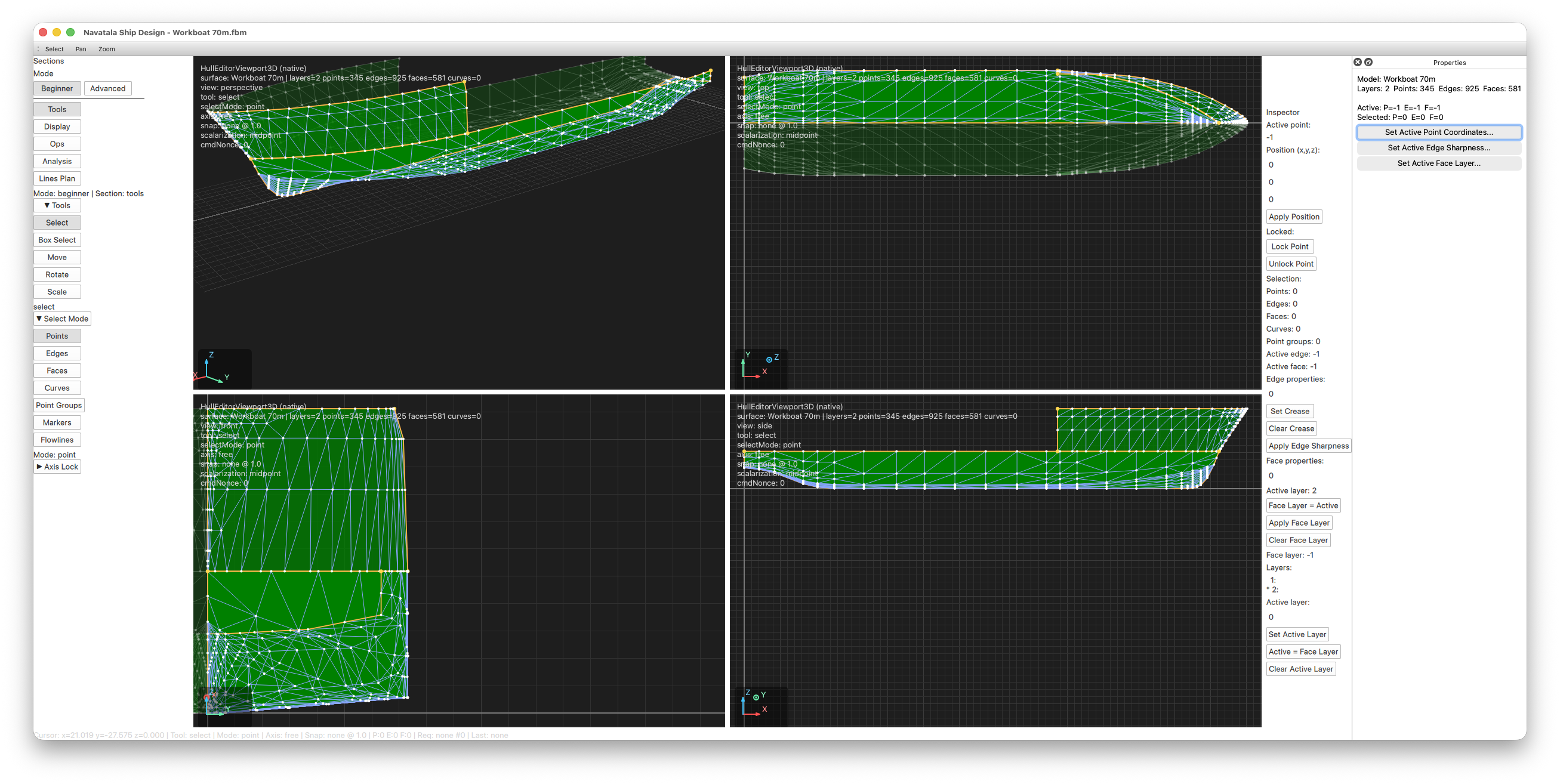
Professional ship design CAD with formal-methods underpinnings. From initial hull form to production planning, with GPU-accelerated computation where it matters.
- 3D hull modeling with subdivision surfaces and NURBS
- Hydrostatic and stability calculations
- Structural design: plating, stiffeners, framing
- Resistance and propulsion estimation
- GPU-accelerated CFD workflows under active development using
navatala_gpu - Image digitization: convert legacy drawings to 3D models
- Production output: plate development, shell expansion, nesting
Condition twin — Talika VIR
The as-inspected state: walkthroughs, deficiencies, and evidence.
Vessel Inspection & Reporting for inspectors who work in demanding environments. Combines offline-first mobile apps with a powerful web administration console.
- Configurable inspection templates with versioning
- Round-based walk-through sequences
- Deficiency tracking with photo evidence
- Automated report generation with customizable output types
- Role-based access control and multi-company support
- Delta sync for reliable offline/online transitions
Operational twin — Talika FMS
The as-operated and as-reported state: voyages, fuel, emissions, and compliance.
Fleet Management System for operational intelligence across your entire fleet. Track voyages, fuel consumption, emissions, and regulatory compliance in a single platform.
- Voyage reporting and noon-report workflows
- EU FuelEU Maritime and IMO DCS compliance
- Fuel consumption analytics and optimization
- Emissions monitoring and carbon intensity tracking
- ETL pipelines for third-party data integration
- Dashboard and KPI visualization
Why we call it a twin
The three stages share one specification-driven model. A bulkhead changed in the design twin shows up in inspection rounds; a fuel-flow reading in the operational twin can be reconciled against the as-designed propulsion estimate. That coherence — one model, three lifecycle views — is what makes it a digital twin rather than three independent products.
The compute-heavy parts — CFD, structural solvers, analytics, and future PINN-based digital-twin workflows — are being built on navatala_gpu, our open-source multi-backend GPU and AI kernel corpus. Same foundation under the hood, with the public runtime and kernels available for review.
Interested in the marine digital twin?
Get in touch for a demo or a pricing discussion.